
Introduction to Global Currencies
Global currencies play a vital role in the modern financial system. In an interconnected world economy, countries rely on currency exchange to conduct international trade, investments, and financial transactions. Major currencies such as the US dollar, euro, Japanese yen, and British pound dominate global markets and influence economic stability across regions.
Understanding how global currencies function helps businesses, investors, and governments navigate the complex structure of international finance.
What Are Global Currencies?
A global currency refers to a monetary unit widely used in international transactions and financial markets. While every country has its own currency, only a few currencies are accepted and traded globally.
Currencies are exchanged in the foreign exchange market, often called the Forex market. This market determines exchange rates between currencies and allows businesses and investors to convert one currency into another.
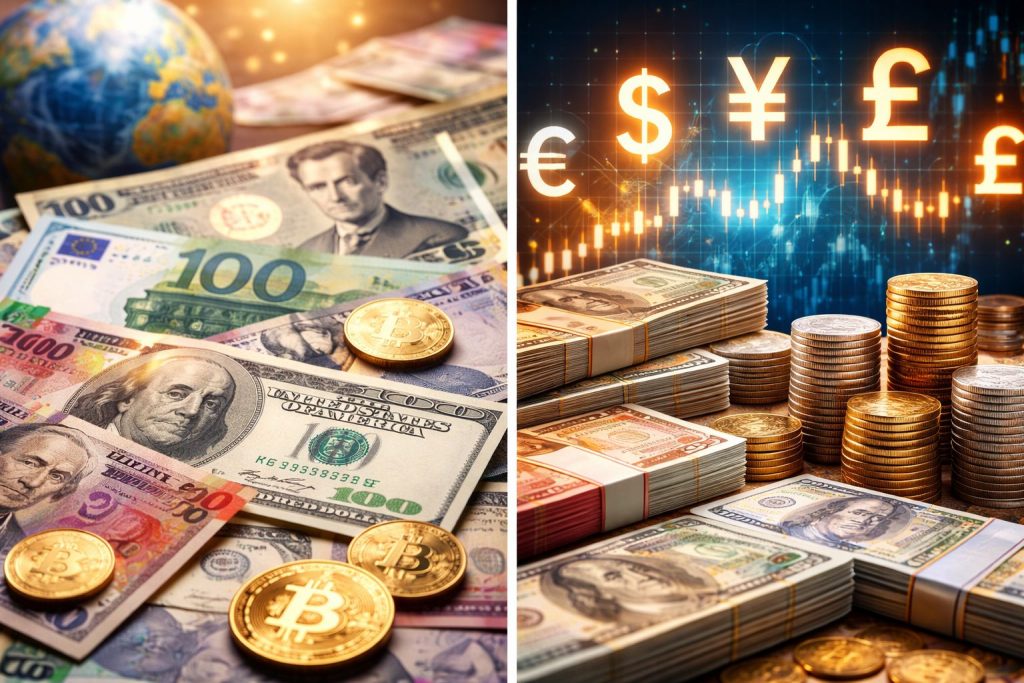
Major Global Currencies in the Financial System
The US Dollar
The US dollar is considered the world’s primary reserve currency. Many global commodities such as oil and gold are priced in US dollars, making it one of the most influential currencies in the international economy.
The Euro
The euro is the official currency used by many European countries. It is the second most traded currency in global financial markets.
The Japanese Yen
The Japanese yen is widely used in international financial transactions and is often considered a safe-haven currency during economic uncertainty.
The British Pound
The British pound remains one of the oldest and most influential currencies in the world, supported by London’s global financial markets.
How Exchange Rates Affect International Trade
Exchange rates play a critical role in global trade. When a currency strengthens or weakens, it can affect the price of imports and exports.
A strong currency may reduce export competitiveness, while a weaker currency may make exports more attractive to international buyers.
Businesses operating internationally closely monitor exchange rate fluctuations to manage financial risk.
The Foreign Exchange Market
The foreign exchange market is the largest financial market in the world. Every day, trillions of dollars are traded between banks, governments, corporations, and investors.
Currency trading occurs in pairs such as:
- EUR/USD
- USD/JPY
- GBP/USD
The Forex market operates 24 hours a day across major financial centers including London, New York, Tokyo, and Singapore.
Central Banks and Currency Stability
Central banks influence currency value through monetary policy, interest rates, and financial regulations. These institutions work to maintain economic stability and control inflation.
Interest rate changes can significantly impact currency value by influencing investor demand.
Central banks also maintain foreign reserves to stabilize their currency during financial uncertainty.
Global Events and Currency Market Volatility
Currency markets respond rapidly to global economic and political events. Major developments such as economic reports, geopolitical conflicts, and financial crises can lead to sudden exchange rate fluctuations.
Investors often monitor indicators such as GDP growth, inflation rates, and employment data to predict currency movements.
The Future of Global Currency Systems
Technological innovations such as digital payments and financial technology are transforming the global currency landscape.
Central Bank Digital Currencies (CBDCs) are currently being explored by many governments as a potential future form of national currency.
These developments could reshape international financial systems in the coming decades.
Conclusion
Global currencies remain a fundamental component of the international economic system. They enable cross-border trade, investment flows, and financial stability.
Major currencies such as the US dollar, euro, Japanese yen, and British pound continue to influence global financial markets.
Understanding how global currencies operate allows individuals, businesses, and investors to better navigate the complexities of international finance.
Leave a Reply